




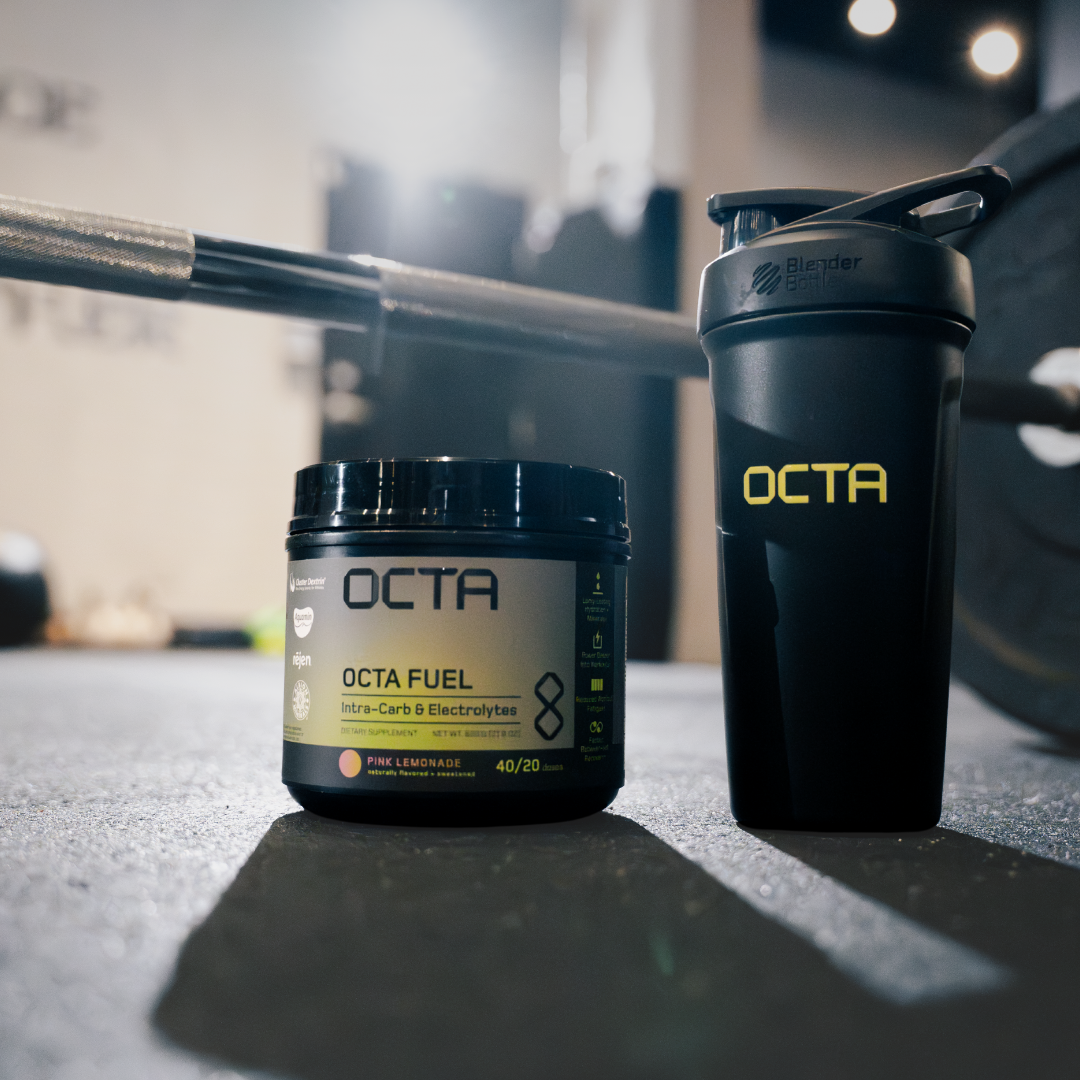
The OCTA Approach
OCTA FUEL was built for the point in training where hydration starts slipping, energy starts dropping, and output begins to fade.
The formula was developed through the combined perspective of a clinical pharmacist who also trains Brazilian Jiu-Jitsu and lifts, and a black belt and conditioning coach who understands what long rounds, repeated efforts, and high sweat loss actually feel like.
Every ingredient was selected because it solved a real training problem and because the science supported the mechanism behind it. Nothing is included for label appeal. Every carbohydrate source, electrolyte form, and mineral has a purpose.
Sustained Energy and Glycogen Preservation
OCTA FUEL is built around carbohydrate delivery that supports ATP production without becoming a digestive problem.
Highly Branched Cyclic Dextrin (Cluster Dextrin®) has a low osmolality and rapid gastric emptying profile, allowing carbohydrate to move through the stomach quickly and deliver fuel efficiently. Maltodextrin provides rapidly available glucose that can support immediate glycolytic ATP production during hard training.
Using both together gives the formula a smoother energy curve — fast enough to help quickly, but steady enough to keep working as sessions extend.
This matters in Brazilian Jiu-Jitsu, wrestling, MMA, long conditioning sessions, and endurance work where glycogen depletion becomes a major limiter of performance.
Reduced Gastrointestinal Stress During Training
One of the biggest failures of many intra-workouts is that they sit heavy in the stomach at exactly the wrong time.
Cluster Dextrin® is known for rapid gastric emptying and low osmolality, which reduces the osmotic load in the gut and helps carbohydrates move through the digestive tract more comfortably.
That means athletes can take in fuel without the bloated, sloshing, or heavy feeling that often comes from traditional carbohydrate drinks.
For grappling, sparring, and movement-heavy sessions, that digestibility is not a luxury — it is part of performance.
Hydration, Electrolyte Balance, and Muscle Contraction
Muscle contraction depends on stable ion gradients across cell membranes.
Sodium and potassium regulate membrane potential and support action potentials through sodium-potassium pump activity. Calcium is required for excitation-contraction coupling, allowing muscle fibers to generate force.
Magnesium helps regulate calcium channels and supports ATP-dependent reactions, while chloride contributes to fluid balance and osmotic regulation.
Together, these electrolytes help maintain hydration status, nerve signaling, and efficient muscle contraction when sweat loss rises during hard training.
Acid–Base Balance and Buffering Capacity
OCTA FUEL uses electrolyte forms that do more than replace minerals.
Sodium citrate can contribute to buffering capacity because citrate is metabolized into bicarbonate equivalents, helping support acid–base balance during high-intensity exercise.
Potassium phosphate contributes to intracellular buffering and also supports phosphate-dependent energy systems involved in ATP metabolism.
As hydrogen ions accumulate during repeated rounds, intervals, or conditioning work, these buffering systems help stabilize muscle pH and preserve output.
This makes the formula especially useful for sports that alternate between sustained effort and repeated high-intensity bursts.
Neuromuscular Axis and Cognitive Support
Performance under fatigue depends on more than hydration and carbohydrates — it depends on the brain-to-muscle connection staying efficient.
L-tyrosine is a precursor to dopamine and norepinephrine, neurotransmitters involved in focus, alertness, and cognitive control under stress.
Taurine helps regulate calcium signaling, supports cellular hydration, and contributes to neuromuscular stability.
Together, these ingredients support the neuronal-muscular axis that helps maintain coordination, output, and decision making when sessions run long.
Cellular Hydration and Mineral Transport
OCTA FUEL includes Aquamin® sea minerals and fulvic trace minerals to support the smaller systems that still matter under heavy workload.
Trace minerals help support enzyme activity, electrolyte balance, and nutrient transport. Cellular hydration is not just about total fluid intake — it also depends on maintaining the mineral environment that allows water and nutrients to move properly into and out of cells.
Supporting that environment helps preserve metabolic efficiency and muscular function during demanding training.

Leave a comment
This site is protected by hCaptcha and the hCaptcha Privacy Policy and Terms of Service apply.